
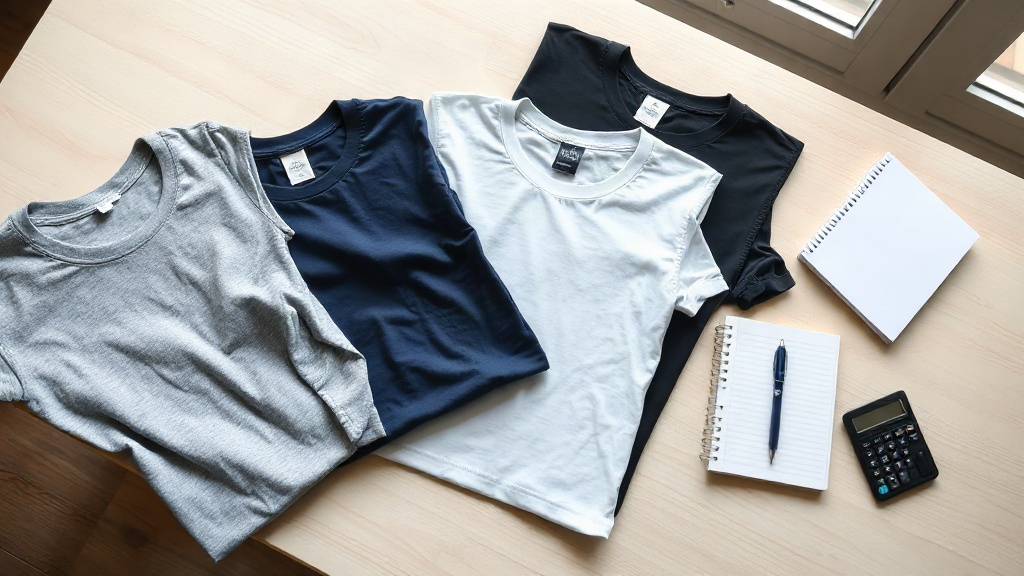
When you're planning to order custom premium t-shirts, whether for your brand, event, or team, the excitement of design often meets the reality of budget. That's where CPS comes in. CPS, or cost per shirt, is a simple yet powerful metric that tells you how much you're spending on each individual t-shirt in your order. It's not just about the total price; it's about understanding the value you get for every dollar. In this guide, we'll explore how CPS can help you make smarter decisions when creating custom premium t-shirts that impress without breaking the bank.
What Exactly Is CPS and Why Does It Matter for Custom T-Shirts?
CPS stands for cost per shirt. It's calculated by dividing the total cost of your order by the number of shirts you receive. For example, if you order 100 custom t-shirts for $1,200, your CPS is $12. But that number alone doesn't tell the whole story. You need to consider what goes into that cost: the fabric, the printing method, the design complexity, and any additional services like tagging or folding. Understanding CPS helps you compare quotes from different suppliers on an apples-to-apples basis. It also allows you to see how changes in quantity or materials affect your overall investment. When you're aiming for premium quality, CPS becomes a balancing act between your desire for the best and your budget constraints.
Why does this matter? Because custom premium t-shirts are an investment in your brand's image. A well-made shirt with a thoughtful design can be worn for years, becoming a walking billboard for your business or cause. On the other hand, a cheap shirt that pills after a few washes reflects poorly on your brand. By focusing on CPS, you can ensure you're getting the most value for your money, not just the lowest price.
Factors That Influence CPS for Premium T-Shirts
Several key factors determine your CPS. Let's break them down.
1. Fabric Quality and Type
The fabric is the foundation of a premium t-shirt. Options range from standard cotton to organic cotton, bamboo, or blends with polyester. Higher-quality fabrics like ringspun cotton or Supima cotton offer a softer feel, better durability, and improved printability, but they come at a higher cost. For instance, a 100% organic cotton shirt might add $2 to $4 per shirt compared to a conventional cotton tee. However, many customers are willing to pay more for sustainable and comfortable apparel, so the perceived value can justify the higher CPS.
2. Printing Method
The printing technique you choose significantly impacts CPS. Screen printing is cost-effective for large orders with simple designs, often bringing CPS down as quantity increases. Direct-to-garment (DTG) printing is great for detailed, full-color designs but has a higher CPS for small runs. Heat transfer and embroidery are other options, each with their own cost structures. For premium shirts, you might consider specialty inks like water-based or discharge inks that give a soft, vintage look. These can increase CPS but enhance the premium feel.
3. Order Quantity
Economies of scale play a huge role. Most suppliers offer price breaks at certain quantities, such as 50, 100, 250, and 500 units. As you increase quantity, your CPS drops because setup costs (like screen creation) are spread over more shirts. However, be careful not to overorder just to get a lower CPS; you don't want excess inventory sitting in your warehouse. Find the sweet spot where CPS meets your actual demand.
4. Design Complexity and Colors
More colors in your design mean more screens in screen printing, which raises setup costs and thus CPS. For DTG, color count doesn't affect price as much, but very large prints or all-over designs can increase ink usage and time, raising CPS. Simplifying your design or using a limited color palette can keep CPS manageable while still looking premium. Remember, sometimes less is more.
5. Additional Services
Services like custom neck labels, hang tags, individual polybagging, or folding can add to CPS but also elevate the unboxing experience and perceived value. If you're selling premium shirts, these extras can justify a higher retail price and improve customer satisfaction. Factor them into your CPS calculation to see the full picture.
How to Calculate CPS and Use It to Your Advantage
Calculating CPS is straightforward: total cost divided by number of shirts. But to really use it strategically, you need to break down the costs. Let's say you receive a quote for 200 custom premium t-shirts at $2,800. That's a CPS of $14. But what if you increase the order to 300 shirts for $3,600? CPS drops to $12. That's a savings of $2 per shirt. Now, imagine you switch to a slightly heavier fabric that adds $1 per shirt but improves durability. Your new CPS might be $13, but the perceived value could be much higher, allowing you to sell at a premium.
When comparing suppliers, always ask for a detailed breakdown: cost per shirt, setup fees, screen charges, and any additional fees. Sometimes a lower CPS comes with hidden costs or lower quality. Don't be afraid to request samples to assess quality firsthand. A reputable supplier like Smart Blanks Market can provide samples and transparent pricing to help you make an informed decision.
Balancing CPS with Premium Quality
Premium doesn't always mean expensive. It means meeting or exceeding customer expectations in terms of fabric, fit, print durability, and overall feel. You can achieve a premium product at a reasonable CPS by making smart choices. For example, choose a mid-weight ringspun cotton that's soft yet durable, use a limited color palette for screen printing, and order in quantities that align with your sales projections. Consider offering a mix of styles: a basic tee at a lower CPS and a limited-edition premium tee at a higher CPS to cater to different customer segments.
Another tip: negotiate with your supplier. If you're a repeat customer or ordering large volumes, you might get better pricing. Also, ask about overruns or slight defects that can be purchased at a discount; these can be sold as mystery tees or used for testing new designs without affecting your main CPS.
Common Pitfalls to Avoid When Managing CPS
One common mistake is focusing solely on the lowest CPS without considering quality. A $5 shirt might seem like a bargain, but if it shrinks or fades after one wash, you'll lose customers and end up spending more on replacements. Another pitfall is underestimating demand and ordering too few shirts, resulting in a higher CPS due to lack of economies of scale. Conversely, overordering leads to dead stock and wasted money. Use historical sales data or pre-orders to gauge demand accurately. Lastly, don't forget to factor in shipping costs; they can significantly affect your landed CPS. Always ask for a quote that includes delivery.
Frequently Asked Questions About CPS and Custom Premium T-Shirts
What is a good CPS for custom premium t-shirts?
There's no one-size-fits-all answer. A good CPS depends on your target retail price and quality expectations. For a premium t-shirt that retails for $30-$40, a CPS of $10-$15 is often reasonable. This allows for a healthy margin while covering marketing and overhead. If you're selling at a higher price point, you can afford a higher CPS for even better materials and finishes.
How can I lower my CPS without sacrificing quality?
You can lower CPS by increasing order quantity, simplifying your design (fewer colors), choosing a standard fabric that still feels premium (like combed ringspun cotton), and opting for screen printing over DTG for larger orders. Also, consider using a single-color print on both front and back instead of multiple locations. Negotiating with your supplier and being flexible on delivery timelines can also help.
Does CPS include shipping and taxes?
Typically, CPS as quoted by suppliers may not include shipping and taxes. Always clarify what's included. To get a true landed CPS, add shipping costs and any applicable taxes to the total cost before dividing by the number of shirts. This gives you a more accurate picture of your actual cost per shirt.
How does CPS differ for small vs. large orders?
For small orders (e.g., under 50 shirts), CPS is higher because setup costs are spread over fewer units. For large orders (e.g., 500+), CPS can drop significantly due to economies of scale. However, larger orders require more upfront capital and storage. Find a balance that matches your sales velocity and cash flow.
What are some premium fabric options that justify a higher CPS?
Organic cotton, Supima cotton, bamboo blends, and tri-blends are popular premium options. These fabrics offer superior softness, durability, and sustainability, which can command a higher retail price. Additionally, specialty finishes like garment dyeing or enzyme washing add to the premium feel and can justify a higher CPS.
By understanding and strategically managing CPS, you can create custom premium t-shirts that delight your customers and boost your brand, all while keeping your finances in check. Start by getting quotes from reliable suppliers, calculate your CPS, and make adjustments until you find the perfect balance.